Like how I titled that as if "Fun Friday Fact" was a real thing, like Wordless Wednesday or Meatless Monday? Nope, I just made it up, because I couldn't think of any other way to tell you this little tidbit. It has come to my attention that Cervadil, the prostaglandin insert used vaginally to ripen the cervix when inducing labor, is apparently derived from . . . pig semen**.
It sounds like something totally make-believe, like the kidney thieves urban legend, or a plot element on South Park, or a nickname for a Wack Packer on Howard Stern. But try as I might to discredit this, every source I've been able to find so far seems to confirm that Cervidil is indeed a porcine product.
I have nothing further to say. Aside to note that I hope the label specifies that it is decidedly not kosher. Please, if this is untrue, someone in the know, disabuse me of this notion.
*Title credit to Justine at State of the Heart Parenting **There's a plethora of other links out there, but I include this one because it includes a sentence I never thought I'd read, "I'd much rather have my husband's semen inside of me, than a pig's."
In the new study, researchers used U.S. government vital statistics to show that labor inductions increased from 14 percent of full-term singleton births in 1992, to 27 percent in 2003.
Moreover, those same years saw an increase in the proportion of births at the earlier end of full-term pregnancy. In 2003, 30 percent of births occurred during the 37th or 38th week, versus 19 percent in 1992. And just over 60 percent of full-term births occurred before the 40th week — up from 42 percent in 1992.
The findings suggest that the rising rate of induced labor is a "likely cause" of the earlier births, the researchers report in the American Journal of Obstetrics & Gynecology.
That's what they "suggest", huh? Worthy points are then made regarding the increased risks for babies born in the earliest window of what is considered 'term', but really, guys.
Next up: "Rising cesarean rates seem to be connected to the the increasing number of babies born by cesarean, study shows". And from our weather center, "Blueness of sky leads many to believe sky is blue."
How exciting is that? This is sort of an "unofficial" client, since despite my obsessive independent study, my actual labor support training won't take place until June. It's a long story as to how it came about, which I won't go into for confidentiality reasons, but though I was apprehensive about whether or not it was okay to attend a birth pre-certification, one of the 'senior' doulas in the area encouraged me, saying "You don't need to be certified to hold a woman's hand and bring her a glass of water." True that!
So, as we're heading into the home stretch, the stress and exhaustion of the final weeks of pregnancy are taking their inevitable toll, and mom is anxious to get the show on the road, understandably. Mom's body is gearing up in a number of unmistakable ways, there is no question, and she's a total champ - but there's a lot of stopping and starting and revving up and decelerating, all of which can be so confusing and frustrating. I'm doing my best to reassure her that this is perfectly, absolutely and quintessentially normal, especially for a first time mom. Her due date hasn't even arrived yet, in fact - we have two more days until she's even 40 weeks along, and the hard numbers show that the average length of pregnancy for primips is 41 weeks plus one day.
Yet, I worry that for her, the due date seems like a looming deadline that she has to try to make or even beat, when this couldn't be further from the truth.
When it comes to child development, we know that there is endless variation that all falls within the range of normal. Some babies start teething at 4-5 months, others don't start until 7. Some are crawling by 5 months, some take quite a while longer. Some walk first, some talk first. Sitting up, rolling over, the milestones are endless - and mothers do sometimes get concerned that their babies aren't doing things "on schedule" . . . and they immediately get reassurance from other moms, especially moms with more than one kid, that every child is different and their kid will indeed reach them all in their own good time.
Yet when it comes to pregnancy, we culturally expect every baby to be 'done' at EXACTLY the same time, TO THE DAY?! Makes. No. Sense. Our fixation on one specific, magical date has really done a number on us, so to speak, collectively, to the point where we have come to think of that 40 week delineation not as an estimate but as a deadline. Combine this with a recent study showing that an alarming number of mothers believed the normal length of a pregnancy was 34-36 weeks, fold in an intervention-happy care provider, and add a liberal dash of normal end-of-pregnancy weary impatience, and you have an underbaked recipe for inductions at pandemic levels.
Sorry, my inner food-blogger took over there. Going on: A due "range" is much more realistic, and considering that it can be perfectly healthy two weeks (or sometimes more) in either direction - we really ought to start considering it a 'due month'. Anywhere from 37 or 38 weeks up to 42 weeks can be considered term. Even a "due week" is an improvement. I also like the growing-in-popularity term "guess date" a lot, and am trying to change my own habitual language to use that term more regularly. Now, don't get me wrong, in some cases being truly post-term can be problematic, but this is rare and deserves to be scrutinized on an individual basis, depending on circumstances.
Really think about it. That date is the mid-point on the bell curve of an entire range of days that could be acceptable, not to mention that it is an ESTIMATE in the first place. Hence, its official nomenclature, the Estimated Due Date, a.k.a. EDD. Furthermore, the estimate is itself based on what is often an approximate recollection of LMP. It is a riddle wrapped in a mystery inside an enigma, if you admire Churchill. A mystery wrapped in a riddle inside an enigma, if you liked "JFK". Or a riddle wrapped in an enigma wrapped in a vest, if you're Lisa Simpson. If there was only one thing, only ONE, that I could change about maternity care in this country, the fixation on the singular so-called due date would be a very, very strong contender.
There are a plethora of wonderful resources out there talking about the many advantages to avoiding early inductions, discuss various non-reasons sometimes given to pressure a mom into induction, and in general talking about the vital importance of the final weeks of pregnancy, and I'll share a bunch of them in a minute here, but let me first illustrate one point with a great visual from the March of Dimes:
Quite the difference there, eh? Among the last things to fully develop in pregnancy are the brains and the lungs - two things that I would never want to take any chances with. From a wonderful read titled "Why Every Week of Pregnancy Counts".
New research shows that those last weeks of pregnancy are more important than once thought for brain, lung and liver development. And there may be lasting consequences for babies born at 34 to 36 weeks, now called "late preterm."
A study in the American Journal of Obstetrics and Gynecology in October calculated that for each week a baby stayed in the womb between 32 and 39 weeks, there is a 23% decrease in problems such as respiratory distress, jaundice, seizures, temperature instability and brain hemorrhages.
A study of nearly 15,000 children in the Journal of Pediatrics in July found that those born between 32 and 36 weeks had lower reading and math scores in first grade than babies who went to full term. New research also suggests that late preterm infants are at higher risk for mild cognitive and behavioral problems and may have lower I.Q.s than those who go full term.
What's more, experts warn that a fetus's estimated age may be off by as much as two weeks either way, meaning that a baby thought to be 36 weeks along might be only 34.
Forgive the overzealous marking-up, there, but these are crucial details. Groups like the March of Dimes are getting increasingly concerned about early inductions and scheduled c-sections for this very reason, due to the risk of what is now being called a "late preterm" baby. 36 weeks is an extremely precarious age already- and then what if the "due date" is off, and you've actually got a 34 or 35 weeker? The entirely preventable increase in complications is unconscionable.
As a Midwife, I would say that yes, your cesarean likely could have been avoided just from what you told me. When an induction occurs when a baby and body aren't ready, the body does just what it's supposed to do: it protects the baby. It's not a malfunction of your body, but rather functions rather beautifully in what it's supposed to do. Unfortunately, in the hospital, that means a cesarean for failure to progress. :( But had your body and baby been allowed to work in its own timing, it's very unlikely that you would have had a cesarean at all. I'm so sorry that you were led down that path.
The bolded part about blew my mind. WOW. I never thought of it that way before, but I think this is an amazing truth; in a way (a sad way, but still) a failed induction - in most cases - is actually an affirmation of the wisdom of the mother's body, devoted to its prime directive: protecting the baby. What a revelation! Brilliant . . . and a bit heartbreaking to think of how often it is unnecessarily violated.
I've had a few other lightbulb moments recently, including quite a few from my postpartum doula training this past weekend, of course.
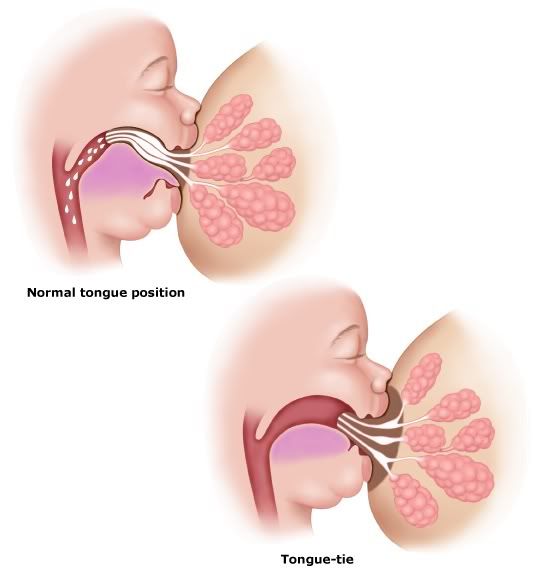
One might seem completely obvious to you, and this is one of those situations where you kind of understand something, but it doesn't really click with you until something illuminates it. I definitely know the basics of breastfeeding, and even understand some unusual complications, due to my own experience. So I know, of course, that the main source of nipple pain when breastfeeding is a poor, shallow latch. And I know that a proper latch means taking in much of the areola, not just the nipple. I've even heard hard and soft palate mentioned in discussion of this before. But it wasn't until we watched the short film "Follow Me Mum" that I visualized exactly how this functions! Latched on to it, if you will.
The above isn't from the film, but it shows the physiology pretty well. Feel inside the roof of your own mouth, and notice where the palate changes from hard to soft. Now take a look at the top image: In the film, they distinguished between the hard and soft palate, and it was crystal clear to me how, if the nipple extends far enough back, it will be compressed against the SOFT palate and will be comfortable. If it doesn't, as shown by the example below with a tongue tie (though other factors, like positioning, can cause this to happen too), the nipple instead is going to be compressed against the HARD palate instead. Ouch!
If this is patently obvious to you already, then more power to you, but I really have a deepened understanding now. I grok this in fullness.
Another revelation from the workshop, that was more of a "DUDE, how cool is that?" moment: Babies spend about 50% of their sleep cycle in REM sleep. Did you know that babies, unlike adult sleep cycles, enter REM sleep first? Maybe you did. I remember reading that as well. Cool enough.
But did you also know that a breastfeeding, cosleeping mom's sleeping pattern actually adjusts to her baby? Even though she is an adult, she, too, will enter REM sleep first, and will follow the baby's cycles, and is thus more easily rousable when baby stirs to nurse. "Physical closeness causes a mother and baby to share sleep cycles. A baby usually wakes during light sleep and the mother is then likely to be in light sleep as well. She can settle the baby without her sleep cycles being seriously disturbed. Awakening from deep sleep is what leads to exhaustion." How freaking amazing is that? (All the cosleeping info on that whole page is very worth reading, by the way.)The more I learn about breastfeeding, the more I understand how intricate and miraculous the relationship between mother and baby is; the "breastfeeding dyad".
Finally, one other lightbulb from an ICAN webinar I attended the week prior to our training weekend. Insert another disclaimer about how this might already be obvious, old news to you. The topic of induction came up (bringing us full circle to the beginning of this post). Toms of great info is being shared, particularly about the various ways that early induction works against the mother's body - there have been a plethora of posts about this lately, like the aforementioned Unnecesarean one on postdates, as well as the recent multitude of riches included in the blog carnival from Science and Sensibility on letting labor begin on its own - so I won't even get into it here (definitely check the carnival out, though).
Where was I? Oh yeah, the webinar. We were talking about induction, and that led to the overdiagnosis of cephalopelvic disproportion. A childbirth educator and doula remarked that before reaching term, the relaxin released by mom's body throughout the course of the pregnancy, designed to allow the ligaments to stretch and therefore open the pelvis, may not have had enough of a chance to complete its job. AHA! We know that the Big Baby card is often a load of hooey anyway, for a number of reasons spelled out here, but here's yet ANOTHER reason. (Side note: relaxin also helps to soften the cervix by breaking down collagen.)
So there's a sampling of recent a-ha's, not to go all Oprah on you. Whether you learned a new tidbit or two, or whether you got to go "Pfff, she didn't get that already? What a rube," I hope you enjoyed.
 Like how I titled that as if "Fun Friday Fact" was a real thing, like Wordless Wednesday or Meatless Monday? Nope, I just made it up, because I couldn't think of any other way to tell you this little tidbit. It has come to my attention that Cervadil, the prostaglandin insert used vaginally to ripen the cervix when inducing labor, is apparently derived from . . . pig semen**.