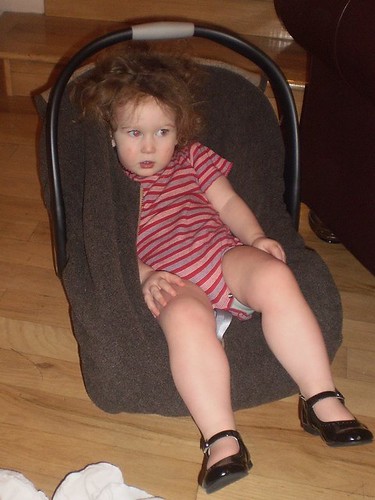
Some comments* in the last post reminded me once again of a recurrent thorn in the side of many breastfeeding advocates: the slur "Breastfeeding Nazi" or, slightly more punchily (though no more wittily), "TitNazi". It comes up frequently in the comments threads on any article or post where lactivism is discussed, particularly if the topic is a controversial one, but even if it's a fairly benign jumping-off point, the ensuing discussion still sometimes spirals off into some pretty nasty territory.
This really bothers some advocates out there, and both Amber Strocel and PhD in Parenting have written eloquently about their objections to the term and how insane it is to compare breastfeeding support to, you know, the mass murder of millions. Other lactivists feel that overreacting to this moniker is, well, an overreaction, and argue that while they disagree with using such a slur themselves, and that the term is definitely insensitive and inappropriate, it's more about fascism than it is about comparison to actual genocide. And thus, from this POV, overreacting to the term distracts from the real issues.
I honestly see good points from each lactivist camp, I really do. Some might say that's the diplomatic tendency inherent to the Libra ascendant in my chart. Others might say the very concept is malarkey. And I can see both sides. See, there I go again! Anyway, my problem with this whole thing? Bottom line? It's dull, unoriginal, and unimaginative. It's just plain LAZY. Really, all it does is draw attention to poor rhetorical skill and a rather embarrassing lack of creativity (substituting "boob" for "tit" isn't much of a flourish, guys).
If you're going to go there, go all the freaking way, man. I'm not a TitNazi, I'm a member of the Breastapo! La Leche League meetings? More like The Nursenburg Rallies. Lactation consultants? Elite officers of the Lactwaffe. Nurse-ins to protest businesses discriminating against breastfeeding moms? Why, that's a full-blown Titskrieg!
Can we invoke Godwin's Law* already (whereby the first person to make a comparison of their opponent's views to Hitler and/or Nazi Germany automatically forfeits the argument) and give this a rest once and for all?
THIS is all we are saying. **
*Not that the commenters herself was making this slur; they simply mentioned how it comes up in such conversations. Just wanted to be clear.
**Indeed, this is tongue-in-cheek, as much as my own punnery above.
** I looked around in vain to credit the original LOLbaby creation featured here. Do claim it, if it's yours! (And please don't be mad at me for besmirching it so.)
A woman posts on a public online parenting forum, expressing feelings of discouragement about how her breastfeeding is going. She doesn't think she has enough milk, and has been supplementing with formula in a bottle, including one overnight feeding, as her mother-in-law wants to help her get more sleep (and has insisted that she move the baby from the bassinet in the master bedroom to the crib in the nursery). She has tried pumping but says she's not getting more than an ounce at a time, further cementing her belief that her breasts are just not working correctly. She confesses she's about to throw in the towel.
In just about every forum that exists, the response is usually immediate: breastfeeding advocates of all stripes begin offering advice for all kinds of different strategies she could use to get her nursing back on track. (If you're reading this, you probably thought of a few things right off the top of your head already, didn't you? I know I would have, if I hadn't written it myself.) Some of the comments are phrased more supportively and sensitively than others, but the objective is to arm the mother with information and cheer her on. Then, when the mother quits breastfeeding, if she feels guilty about it, the source of that guilt, in her mind, becomes the breastfeeding advocates who she now perceives as pushing and judging her.
And the lactivists feel frustrated that their advice and efforts seemed to go unused, or fell on deaf ears altogether. But why be frustrated? This was just one woman, and it's ultimately her choice, her prerogative as a parent to weigh the risks and benefits of her feeding choices and how they will impact her child. It doesn't affect the lactivists personally. It's really none of their business.
Why DO breastfeeding advocates, or lactivists, if you will, often get very worked up about, and seemingly invested in, other women's breastfeeding stories, particularly if their attempts to breastfeed were unsuccessful? Why do we seem to insist on making the personal into the political? Where does individual choice come into the discussion? Sensitive questions with complicated answers. Part of the answer includes the public health aspect, the impact on both infant mortality, and even the economy - all of which are extremely well-covered by other bloggers and a huge variety of articles.
One aspect of the answer I'd like to zero in on: I think one major reason many lactivists work so hard at helping women to succeed does go beyond helping that individual woman. This individual help is the most important thing, of course, and while one could argue that breastfeeding might not be the right choice for every mom, as some have observed, it is right for every baby*. Yet here's where it goes deeper: every time a woman publicly struggles with some aspect of breastfeeding - say, on a message board, or a blog, or on Twitter, and then succeeds due to being given good resources, support and information, other women see this example and learn from it. And every time a women publicly struggles and does NOT get the same quality of response, other women see this example and learn from it as well - and may not have any idea that the right resources, support and information could have made any difference. [Disclaimer: there are situations where breastfeeding is truly not possible, as in the infant conditions in the footnote, and the exceptional instances where low milk supply is a reality. They are incredibly rare, but also very real and certainly deserve respect (and frankly, more research).]
But even beyond that, there's another part of the picture that circles back to the matter of mother's individual choice. I saw this comment by Mary Woodring on the Facebook page for Peaceful Parenting the other day, and hereby hit "Like" a thousand times over. THIS is the rub, and the inspiration for this post:
"When a woman is unwilling to breastfeed, but tells people she was unable, it inflates statistics and seeds fear in other women that breastfeeding is an unreachable ideal for most women."
Yes.
Thank you.
There IS a flip side to that - and I can already feel the murmurs. In order for women to feel safe about publicly admitting that they were simply not willing to breastfeed, and that it was a choice, not some failure of their anatomy or - another frequent claim - "refusal" by their child*, we, as a breastfeeding advocacy community, need to be able to accept those choices and not condemn or harass these mothers who have made different choices.
Now, two immediate points: First, I definitely feel that the lactivists who TRULY do bully and judge mothers are in the minority. Far too often, advice is solicited, and then when things aren't working or the mother makes a different choice, the advocate becomes a scapegoat and a target of their own guilt, as in the example above. We've all seen it happen. But we also all know there are times when lines are crossed and unfair judgments are made . . . even insults. This needs to stop, and we need to make an active effort, even in the cases where guilt over the choice to formula-feed is directed at us inappropriately, I feel that it IS worth it to make doubly sure that we are kind and nonjudgmental. Annie of PhD in Parenting recently wrote a masterpiece on this matter, a post which I have made my personal mission to work on embodying. It's not easy. It does involve biting my proverbial tongue and sitting on my literal hands at times. But in order to move forward and start being able to make a clearer distinction between the "I couldn't" moms and "I wouldn't" moms, I think it's very much necessary.
Secondly, and I can't emphasize this part enough: being willing to accept mothers who have made the choice to formula feed and treat them respectfully does not, not, NOT mean cutting back on promoting information about the benefits of breastfeeding/risks of artificially feeding. Nor do we reduce efforts to provide moms with solid support and resources and information, and especially easing the access to all of the above. On the contrary, I feel it's all the MORE reason to redouble such efforts.
There are many, many moms out there who had no desire to breastfeed for any number of reasons, many of them cultural but some of them personal - and yet, after learning more, and more, and more about how dramatically it would benefit not only their babies but themselves, they slowly changed their minds. I know one such mother who started out being totally turned off by breastfeeding with zero plans to do so herself - who is now becoming a lactation consultant as a result of her experience. You probably know one too. They're out there, and they matter, and they can become some of the best counselors of all, since they've been there themselves.
If information and resources are copious and available, some of those moms who were initially unwilling might make the transition all on their own, and then, in the absence of judgment, the remaining mothers would be able to be honest and forthright about their choice WITHOUT perpetuating myths about their "inability" to breastfeed.
Let's all assume that mothers, with very few exceptions, actually do do the very best they can with the information they have at the time. Look how this gives moms the benefit of the doubt, assuming the best intentions, AND underscores the need for copious, accurate, easily accessible information. I am CERTAINLY not saying we throw in the towel, far from it. I'm saying we need to work harder and work smarter. Getting the information out there as positively and honestly as we can without diluting the message (that might seem cryptic, but it's best saved for another post) is mission critical. And I feel that reducing the number of mothers who state publicly that they could not breastfeed when it isn't actually true could have a major impact.
You may say I'm a dreamer, but I'm not the only one (I hope).
Nova Scotia, I salute thee. This is possibly the best PSA campaign I've seen for breastfeeding yet.
After a particularly lively week of breastfeeding in the news, this is a breath of fresh air. I love the simplicity and directness and inherent compassion here. In the, um . . . lively comment sections that follow, lactivists are typically accused of understating the potential difficulties of breastfeeding, and overdoing it with the "It's just natural! Thus it comes naturally!" approach. While I might disagree with that characterization in most cases, and there's plenty to discuss in terms of detrimental outside influences, I do think it's a point worth taking into consideration.
So, how perfect is this? It doesn't even get into the benefits of breastfeeding/risks of formula - because really, where to even begin in :33? Instead, the message they send is one of support and understanding, of affirmation that there is indeed a learning dynamic at work, and use wonderful analogies. I particularly like the language one, not only because it really is like learning a language (one that you are learning together with your baby), but also because but also because relationship is fundamental to language.
See, those cats are American lactivists, and that squirrel is this PSA campaign. Or perhaps the nuts are the campaign, and the squirrel represents Nova Scotia mothers? Maybe the nut is breastfeeding itself, and the squirr . . . Point being, DO WANT PLZ.
I can own up to it: a fair portion of my social life actually takes place on Facebook these days, due to (a) living really far away from many of my friends and (b) the limited time out in the real world that comes with being a mostly-SAHM. As such, being me, I post at least as many links to birth advocacy, lactivism, gentle parenting and other related topics as I do links to the latest LOLcats, pictures of my kid, and videos mocking Glenn Beck.
Sometimes I wonder how the former category comes off to my, well, civilian friends, particularly when it comes to lactivism regarding breastfeeding in public. I wonder what they think of phenomena like Facebook's censorship of many breastfeeding pictures, and responses like the ever-growing group "Hey Facebook, breastfeeding is not obscene!" I'm sure that my links have met with more than one pair of rolled eyes. Yeah, yeah, we all know "breast is best", but there are more important things going on in the world. And sure, I guess moms should do it if they can, but what's the big deal about having to do it in public?
"A recent article published in Australia's Herald Sun indicated that many Generation-Y women polled would not nurse their babies because of fear of embarrassment over public breastfeeding. As much as 75 percent of these young women felt that nursing in public was uncomfortable and few understood the benefits of breastfeeding for themselves or their babies."
As long as breastfeeding is stigmatized, as long as nursing mothers are made to feel uncomfortable and unwelcome, as long as women are pressured to cover up or go to private areas (if this is the mother's preference for her own reasons, including religious ones, this is certainly her prerogative), women are going to be deterred from breastfeeding at all, despite the risks of NOT doing so - risks that affect both her child and herself.
It came to my attention not too long ago that Medela, probably the largest manufacturer of breastfeeding-related products, might be less than squeaky clean in terms of their compliance with the very important WHO Code regarding marketing of formula, bottles, and other breast & breastmilk replacing products. But I managed to coast along in denial for a while longer, having had Medela products play such a huge role in my daughter's long and exhausting road to the breast.
Their high quality, extremely efficient Advanced Pump in Style double electric breast pump was what got Lily fed, period, for the first 5 months of her life, while my LC and I worked at various strategies to get her to latch. Using the SNS was an important step we needed to take along the way (though I ultimately found the Lact-Aid to be superior), as were their nipple shields. And primarily because I became emotionally invested in them, I also purchased accessories like their breastmilk storage bags, breast shells to help draw out flat or inverted nipples (and to air-dry them if sore or healing), their travel wipes for the pump, and the microwave steam cleaning bags. It’s convenient when the pump you’re using fits with the bottles you want to use, when replacement attachments are readily available, and when you feel like there’s a consistent quality there that you can trust. I completely understand that kind of brand loyalty.
Because I was such a loyal customer, it was all the more stinging to read this post by PhD in Parenting last week, full of serious truthiness as it is. I won't rehash the entire thing here, as she has done such a good job already, as did the above much earlier post from Hoyden About Town - do go check them out for yourself. Suffice it to say that not only has Medela flipped the bird at the code, marketing bottles in violation, they're now making matters even worse with this sly, underhanded "Medela Mom Mavens" campaign.
I can understand, to a degree, that it's a tricky line to walk at times. Having some of these products available, like the ones my daughter and I benefited from during our insane nursing saga, is important. They should be available to moms who need them, and easily so. I am thankful that when I needed a different size nipple shield, I was able to run out to the local big box baby store (more on that in a sec) and pick one up. I'm thankful that replacement attachments for the pump were similarly conveniently available. I am thankful that the moment it seemed like my situation might call for an SNS, my LC was able to hand me one immediately. Such breastfeeding support products can make a HUGE difference in breastfeeding success when there are complications. As Annie at PhD in Parenting says:
I don’t want to be overly critical of Medela. I think the company does a great job promoting and facilitating breastfeeding. Most of the information on its website is wonderful. Most of its products are of the highest quality. I have been nothing but happy with my Medela products. However, I do think that some of their current actions to promote their bottles are inappropriate. It would not be difficult for Medela to continue to promote breastfeeding and sell its bottles without promoting them. However, it has chosen to ignore the WHO Code and push more bottle imagery and bottle messaging on moms (more on why bottle imagery and messaging is hurtful here). The result is that Medela is directly pushing bottles on moms and also doing so indirectly via the Medela Mavens and others who might pick up on the message about how breastfeeding ties you down, so you really need a pump and bottles so you can get your hair done.
To be clear, on a sliding scale this is not even close to Enfamil or Nestle or other formula companies. Not even close. But I would argue, and others do argue, that any violation of the WHO Code weakens its potential impact. We cannot say “it’s okay because you are Medela,” but then slap Nestle on the hand for everything it does wrong.
Lines have been crossed, not only in the clearer terms of promoting their "breastmilk bottles", but in the more nebulous grey area of promoting products over breastfeeding. I've been mulling all this over for a few days, and trying to find a way to put that thought into words, and then I went to the big box baby store yesterday, a trip that was disappointing on two levels.
I was there to drop off some flyers for the upcoming doula training I'm sponsoring, as well as some business cards. The last few times I was there (hey, pickin's are slim in this town), probably 2 months ago or so, there was a small table behind the registry area where local birth and baby-related services could leave their materials. There was never a lot, but there was a brochure for an independent childbirth class, cards for a breastfeeding support group, a small calendar of mom's playgroup activities, that kind of thing.
When I walked in yesterday, the table was empty. I asked an employee whether it had moved, or if there was another area to post about things like childbirth classes - a community message board, perhaps. She told me that no, they had decided to not allow outside materials any longer. Disappointment #1, in terms of small businesses and independent agencies. But hey, she said, they have some classes of their own! She pointed out the board below:
Here's a closer look:
A "Breastfeeding 101" workshop, sponsored by You Know Who! A basics of breastfeeding class whose description begins with "Ready, set, pump!"
If that doesn't make their priorities clear, I don't know what will. Believe me, I know firsthand that a pump is sometimes absolutely essential. And certainly it is for mothers who work outside the home. Hallelujah for them, seriously. But a breastfeeding class that focuses first and foremost on pumping? The rest of the description: "Get the scoop on breastfeeding and all the great products sure to make it easy to feed baby naturally." I mean, it's not that I was surprised to see a live, in-person infomercial for Medela products disguised as a breastfeeding "class". Especially not at a big box store (with similar classes in car seats, sponsored by Graco, and the like). I'm not so naive. Just very, very disappointed.
So, like many other lactivist moms out there, I can no longer in good conscience continue to promote Medela products. So what to recommend in its place? Just West of Crunchy has an excellent and thorough post on the matter, which starts out bemoaning the same state of affairs and then goes on to explain the Hygeia and Ameda pumps, both of which sound great - in addition to being WHO compliant, and proudly so, unlike some people, they are also closed system pumps, much preferable to Medela's open systems. She explains it all adeptly here:
If more mothers knew the facts about their beloved Pump in Style pumps, Medela would be selling a lot less of them. And I can speak from experience, I have a PIS sitting in my closet, waiting to die a slow death in a landfill.
Why? Because it can't be given to anyone else. That's right, my $280 breastpump has to be tossed in the trash. It's not FDA approved for more than one user. Even though I only used it maybe 30 times. And I know there's a huge black market for the sale and donation of used single-user pumps, but you know what? Even if I could, I wouldn't give the thing away to another mom. Because once you know the facts on the Medela pumps, you won't want to use them.
There are "closed system" pumps and "open system" pumps. Medela is the latter. Having an "open system" means that milk can contaminate the tubing and the motor to the pump. And while the tubing can be cleaned or replaced, the motor cannot. Which means if my milk makes it into the motor, so could a hypothetical seccond user's, at which a time they'd mix. The motor can't be cleaned or sanitized, and there's no way to know if milk ever contaminated it. So, if you're using a second-hand pump, it might be clean, or it might not. Your guess is as good as mine.
But even if you follow the rules an purchase a new Medela pump, keep it, and never allow it to be used by a second party, you can still have problems. It's important to note that Medela is completely open about their pumps being single-use only, they're very forthright about that. The information that's lacking, though, is that you can actually end up with MOLD in your pump motor and tubing, due to the open system design. The milk that you can't see in the motor - that you have no way of knowing whether it's there or not - can grow mold inside your pump. You can also end up with mold in the tubing (a lesser problem, as that's replaceable).
I don't know about you, but I'd rather have a pump that has ZERO chance of developing mold in its motor. Both Hygeia and Ameda offer pumps that have closed systems. You're not going to get milk in them, because the way they're designed, there's no backflow. Not only are these WHO Code compliant companies, they make superior products!
I took a look at Big Box Baby Store's pumps to see if they had either of the above. Nope. [See update below!] They had one Lansinoh electric pump, and one Evenflo hand pump, and the rest was, of course, all Medela, all the time. So, it's frustrating. Medela is no doubt the most widely available. You can go see them for yourself, talk to a salesperson, and take one home the same day. Ordering things online is less appealing and even prohibitive for some people. But I have to recommend doing so nonetheless, at least until/unless Medela does a serious 180 (and I would be thrilled if they did). If you're lucky enough to live in an area with smaller businesses that might sell alternative pumps directly, then hooray (for that among other reasons).
What about some of the other products, though? Smaller ticket, yes, maybe not as big a deal to the company, but still. I can make a few recommendations. For the best storage bags: I always liked Lansinoh's. And I honestly would recommend the Lact-Aid over the SNS even if Medela was behaving ethically - same basic concept, but the difference in user-friendliness is HUGE, and again I must point out that Lily would NOT be nursing today were it not for the Lact-Aid - along with the brilliance of my LC of course. But I digress: As for nipple shields, that's one where I'm stumped. Breast shells as well - I know that for drawing out inverted nipples, Supple Cups are now available, and reputed to be very good, but for helping to air-dry sore or wounded nipples, I'm not familiar with an alternate brand. Lactation pros, moms with nursing challenge experience, do you have any ideas? Please chime in.
I close with the following from the Hoyden About Town piece, on the insidiousness of Medela's current marketing:
[Medela's commercial states:] “When you choose to breastfeed, you’re doing what’s best for your baby. When you choose Medela breastfeeding products, you’re doing what’s best for you both.”
Medela is saying, directly, that breastfeeding is not best for women. It might be ok for babies, sure, because they get the breastmilk, but Medela is telling us loud and clear that pumping is better for mothers than breastfeeding is. No qualifications, no circumstances; just “pumping and bottle-feeding is best for women”, with a side serve of “and it’s just as good for babies”.
This isn’t just a WHO Code violation; it’s not true. And it’s a lie fed by all of our dysfunctional societal issues around breasts and breastfeeding and public feeding and mother-child attachment and women and the workplace. It’s fed by the huge pile of myths about how easy pumping is, and about how bottled stored breastmilk is just as good, and about how it’s vital to schedule feeds and “see how much babies are taking”, and about how babies don’t know when they’re hungry or thirsty or full or in need of comfort. The problem is, it isn’t just fed by those dysfunctions, it’s feeding back into them, reinforcing them.
These sorts of advertisements are part of the huge coercive societal mechanism denying support for mothers and children, part of the capitalist machine preventing women from being able to afford time with new babies, and keeping them being good little workers and consumers. I think it’s no coincidence that two countries with no moves towards a full legislative implementation of the Code, the USA and Australia, are also the only two industrialised countries in the world without mandatory paid maternity leave.
Words mean stuff. Marketing is powerful. Advertising works.
And it makes a whoooole lot of money.
*****
UPDATE 8/31/10: Ameda pumps are available in Babies R Us nationwide now, and not only that, the Lansinoh double-electric pump for $150 is actually an Ameda pump, rebranded, and at half the price.
*The hospital-grade pump Symphony pump IS a closed system, so this is the one exception in the Medela line, ethical issues notwithstanding. Moms needing to rent these when there's not an alternative brand available should feel safe.
I usually feature a video on the weekends, but then I saw THIS. "Abundance" from the Piazza Maggiore, in Italy, taken by Gio. Thanks to Whoz Your Doula!
Continuing the thread from the other day's post, here are some great commercials promoting breastfeeding - wherever baby needs to nurse. First from Canada:
No, not a new reality offering from Fox. I'm speaking of the phenomenon on Twitter that has been happening on a regular basis since the #bfing hashtag entered the Tweetgeist, wherein someone makes a snide remark about breastfeeding, usually regarding nursing in public or duration of nursing beyond whatever age they feel personally feel is acceptable, and the RTs with #breastfeeding, #bfing and #lactivism start a-flying*. The original Tweeter is then inundated with responses from breastfeeding advocates worldwide, and almost invariably gets more and more defensive by the @reply.
I've joined in too, when my timing is right, and have witnessed even more. Most of the instigating remarks, I'm sad to say, I've kind of gotten used to - I mean, spend even a few months online reading about the topic in various internet forums, and you're bound to encounter tired old tropes like the typically ignorant "If he can ask for it, he's too old to nurse," and the mockery of all things logical that is "I know it's natural and all, but so is poo - do it in privacy of the bathroom." But I truly heard a new one just a few days ago.
Are you sitting down? Well, I guess you probably are, seeing as how this is on a computer screen. Are you currently in the process of consuming a beverage? Finish swallowing, put the drink down. Okay, then, read on**:
AlanArbelaez:Theres a woman #bfng out in the open, tits exposed. Wtf is wrong w/her? It's like a man feeding his baby w/his penis.
It's like a man feeding his baby - with his penis. I'll give you a moment to process that.
Yes, this really was taken from him verbatim. What's amazing is that only a handful of lactivist Tweeps descended upon him - and did a fine job, might I add, most notably MommyNews, LactatingGirl and Morgaine_LaFay. Kudos, ladies. In terms of sheer numbers, he got off easy, relative to the statement he made. But I was truly astonished that he didn't backtrack whatsoever. Subsequent Tweets of his included these gems, roughly in order of the 'conversation':
@MommyNews you wouldn't want to see a mans penis out in the open like that right? Well why is it ok for her to have her tits out?
@MommyNews If a woman wants to breastfeed in public, do everyone a moral and ethical favor and COVER UP!
@Morgaine_LaFay It's not about looking or not looking. It's the fact that you are showing your breast in public that offends people.
@MommyNews no, what offends me is the pure lack of common sense and her audacity to breastfeed in public without covering herself.
@LactatingGirl I don't want to. Milk bottles exist! use one and you can avoid annoying your kid and the public.
@LactatingGirl I kno that, but as a collective opinion, people find exposed breasts in public, offensive. Surely you can't disagree on that!
RT this. I will stop being offended when i can look at woman breastfeeding and she won't look back at me with a mad/weird look on her face.
Finally, he retweeted one of his own, a friend chiming in to support his views:
RT @phyliciax3 @Alan Arbelaez I saw a lady doing that last month, couldnt believe it! lol; people act like its normal, cover urself @ least!!
I came in after the fact by about an hour, so couldn't do much more than RT the "feeding a baby with his dick" quip, to which he later responded, saying:
Alan Arbelaez @Dou_la_la That actually sounds hilarious! but no, you are twisting my words. check the convo @MommyNews and i had before you RT stuff.
Which I had, of course (see above), and I informed him that directly quoting someone cannot possibly be "twisting" their words. It's not even remotely taken out of context, either. So goes another day of great rhetoric on the internet. Are we as a (very loosely defined) community overreacting to things like this? Why get worked up about one isolated Tweet, or even one Tweeter? He's just a 19 year old kid, after all.
Why? Because underlying his outward projection of pseudo-chasteness is the perversion of the primary, if not entire, biological raison d'etre for breasts, period. If that sounds intolerably prudish, bear with me (I've got nothing against a little healthy perversion in the right situation). The original purpose of breasts is actually not to provide visual stimulation for men or accessories to their arousal, not that you'd guess it if you were an alien to this planet leafing through pretty much any magazine or channel surfing on even basic cable. Breasts have become sexualized - fetishized, I daresay - by our culture. Hence, our 19 year old's joke about feeding a child with his penis really does reveal EXACTLY what he thinks about breasts: they are sexual organs, and hey, his penis is a sexual organ, so in his mind, why would feeding a baby with his penis be any different? Many a true word is Tweeted in jest.
The above is not to say that I don't relate to the aesthetic appeal of the human body, including the female form - I most certainly do. Do I buy into it to a degree, even if mostly unconsciously? Like an animal lover reconciling their dietary compromises with their idealism, I have to admit that I do. I own cleavage-revealing clothing and bust-enhancing bras, and have been known to, let's say, exploit my own figure from time to time. And it's also not to say that a woman's own experience of her breasts as an erogenous zone is not legitimate - believe me, I most definitely understand that too. But this is all about context, and about reducing the damage, just as it is with the analogy of our food choices, and starting to change the entire framework. I am certainly not saying it has to be one way or the other - breasts are EITHER for aesthetic and sexual pleasure OR for feeding babies only. I don't believe this has to be mutually exclusive. But I do think that choosing the former over the latter is both destructive and completely irrational.
Getting more fundamental, why else is changing this perception important? Because every negative remark to the effect that a mother had the "audacity" to nurse her child - i.e. feed her child according to the biological norm - within view of another adult is a remark that shames, and that shame may contribute to another woman deciding to cut her breastfeeding relationship short, or to never start one at all. It may cause her to feel guilty and uncomfortable and defensive about nursing throughout her baby's time at the breast, to the detriment not only of her baby but of herself as well. And our already low breastfeeding rates are nothing less than a national health crisis.
*Twitter terminology: RT is a retweet, as in reposting someone else's statement. And putting # in front of a word is called a hashtag, which makes that tweet searchable & thus spreads it to a wider audience of people looking for tweets on that topic.
**If you're unfamiliar with Twitter, the posts with @ plus a name right afterward are Tweets from this guy replying TO the person named, i.e. if it started with @Dou_la_la, it would be addressed to me.
EDIT: I originally withheld the name of the Tweeter in question, but it was recommended that I go ahead and name names, since it's all public domain by definition anyway. I gave it some thought and decided to go ahead. Congrats, young master Arbelaez!
Katie Allison Granju wrote this staggeringly brilliant piece on Babble today, putting the "breastfeeding backlash" in perfect perspective. I could quote practically every sentence she writes, but here are a few choice snippets:
The current breastfeeding backlash is a reaction to a certain intensity surrounding the issue of breastfeeding that did indeed gain currency over the past decade or so. But what today's mothers - the ones who are fueling the breastfeeding backlash with their criticisms and complaints - don't appreciate or maybe even realize is that the activism and advocacy they are slamming was actually an important, grassroots women's health movement that managed to fundamentally change the way our culture views and treats breastfeeding within only about ten years (!!!). And any time you have a movement that erupts out of a sense of frustration and oppression, and manages to turn that frustration into the kind of power it takes to create meaningful change on a big issue, that movement is going to have to be both pushy and loud.
She goes on with the perfect analogy:
Sort of like those women who casually enjoy the obvious fruits of second wave feminists, even as they criticize them, I suspect that many (most?) of today's mothers of babies and young children are completely unaware of how different our cultural landscape is when it comes to breastfeeding than it was only a very brief time ago. They take it for granted that their hospital has a lactation consultant, and that their insurance company will help pay for the breastpump needed to express milk for their premature baby. They can't imagine a world where ALL breastfeeding mothers (and there weren't that many) excused themselves to a cloistered location every time the baby needed to eat, or where the idea of continuing to nurse into toddlerhood was seen as pathologically bizarre. New mothers today can't imagine these things because, before becoming pregnant or having a baby themselves, they never even thought about the topic of breastfeeding, so their only context is Right Now, Today. As a result, far too many women fail to appreciate the "zealotry" that gave birth to the readily accessible breastfeeding resources, support, protections, acceptance and information they now have available; they just don't get why anyone would feel the need to engage in activism or advocacy on a topic that seems so mainstream. I meet many current moms who have this opinion because I, too, am currently the mother of a toddler, just like them.
But I also happen to be the mother of an almost-18 year old, a 14 year old, and an 11 year old. So I remember what it was like when I gave birth to my first baby, in 1991. Things were very, very different even that recently for mothers in this country who wanted to breastfeed, which I did.
She goes on to elaborate, from this unique and insightful perspective, on exactly how and how much things have changed. I could keep quoting ad nauseum, but really, go check it out.
The post also mentions articles that she herself had written over the last decade - and I actually remember some of those articles, as an avid Salon reader from its earliest days. Good stuff. This piece in particular, "Formula for Disaster", from almost exactly ten years ago, is every bit as valid and gripping today as it was then.
Katie, I owe you. I can only hope to be some small but effective part of the third wave.

 THIS is all we are saying. **